How Much Does Slack Cost? Per-User Prices and Real Team Totals
By the SoftSea editorial team
The answer in one table
Slack charges per user, per month, and the price depends on the plan and on whether you pay annually or monthly. These are the list prices from slack.com/pricing, checked on November 18, 2026.
Plan
Billed annually, per user/mo
Billed monthly, per user/mo
Per user, per year (annual billing)
Free
$0
$0
$0
Pro
$7.25
$8.75
$87
Business+
$15
$18
$180
Enterprise+
$45
Via sales
$540
Interactive tool
SaaS Cost Calculator
The per-seat price is the small number. This is the real one: your team, a full year, both billing cycles.
Slack Pro for 10 seats
$870.00 per year
Billed annually: $72.50 per month equivalent, paid once a year.
Billed monthly instead: $1,050.00 per year.
Annual billing saves $180.00 a year (17 percent), if you are sure the seats survive the year. Empty seats paid annually are the most common SaaS waste we see.
Bar: annual-billing cost as a share of monthly-billing cost for the same seats.
Plan prices from vendor pricing pages, checked November 18, 2026. Taxes, add-ons, and usage overages are not included, because vendors do not include them in the headline price either.
What a team actually pays
Per-user prices hide the real number, so here it is at the three sizes people ask about, on annual billing at list price.
Team size
Slack Pro, per year
Slack Business+, per year
10 people
$870
$1,800
25 people
$2,175
$4,500
50 people
$4,350
$9,000
Paying monthly instead of annually raises Pro from $87 to $105 per user per year, an 18 dollar per person premium for flexibility. For a 25-person team that is $450 a year, which buys the right to leave or shrink without a prepaid year. Neither choice is wrong; paying monthly forever by inertia is the only wrong version. Slack's pricing page was also showing a temporary introductory offer, 50 percent off the first three months on monthly billing, when we checked. Introductory offers are marketing, not pricing: budget from the list prices above, because month four is the price you actually live with.
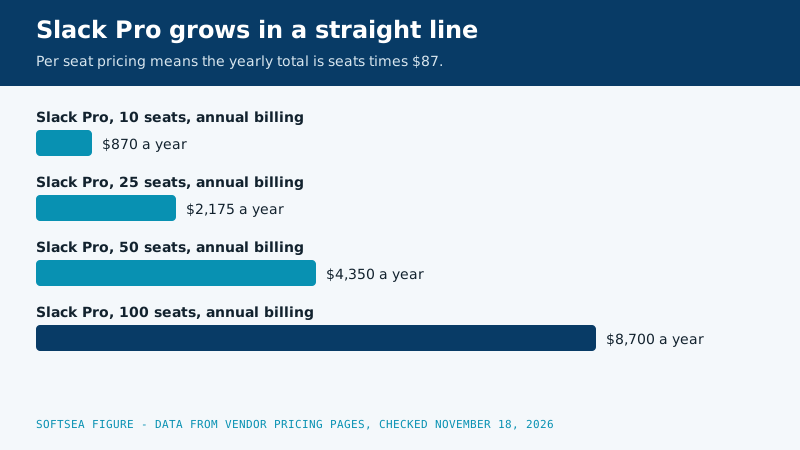
Line style bar chart showing Slack Pro yearly totals on annual billing rising from 870 dollars at ten seats to 8700 dollars at one hundred seats
The full seat ladder: from 10 to 100 people, both paid plans, both billing cycles
The three sizes in the table above are the ones readers ask about first, but growing companies need the rungs above them, and finance teams need the monthly billing column beside the annual one. Every figure below is simple multiplication from the vendor list prices in our data set, checked on slack.com/pricing on November 18, 2026: Pro at $7.25 per user per month billed annually or $8.75 billed monthly, and Business+ at $15 or $18 on the same choice.
Team size
Pro, annual billing, per year
Pro, monthly billing, per year
Business+, annual billing, per year
Business+, monthly billing, per year
10 people
$870
$1,050
$1,800
$2,160
25 people
$2,175
$2,625
$4,500
$5,400
50 people
$4,350
$5,250
$9,000
$10,800
100 people
$8,700
$10,500
$18,000
$21,600
Three readings of this ladder are worth taking into a budget meeting. First, the monthly billing premium is a flat fifth on Pro at every size, so a 100 person company pays $1,800 a year purely for the right to pay monthly; that right is worth buying while headcount is volatile and worth surrendering the moment the roster settles. Second, Business+ costs a shade more than double Pro at every rung, which means the upgrade decision never gets easier with scale: the features named in the plan section below must be worth an extra $93 per person per year whether you have ten people or a hundred. Third, Enterprise+ at $45 per user per month on annual billing would put a 100 person company at $54,000 a year, a figure that belongs in a procurement process with competing quotes, not in a self serve checkout.
What each plan actually buys
The Free plan costs nothing and keeps messages searchable for 90 days, with up to 10 app integrations and one-to-one huddles. The 90-day window is the whole story: anything older becomes invisible, which is fine for a temporary project team and corrosive for a company whose decisions live in chat.
Pro at $7.25 per user per month billed annually removes the two limits that matter: message history becomes unlimited and searchable, integrations become unlimited, and group huddles and Slack Connect channels for working with outside companies arrive. For most small and mid-size teams, Pro is not the entry plan; it is the plan, full stop.
Business+ at $15 doubles the Pro price for administration and AI: SAML single sign-on, user provisioning, data exports for compliance, a 99.99 percent uptime SLA, and Slack's advanced AI features, which are gated to this tier and above. Buy it when your IT or compliance requirements name those features, or when the AI tools are genuinely part of the workflow, not because it sounds like the serious option.
Enterprise+ at $45 per user per month on annual billing, sold through sales, is for large organizations with multiple workspaces and enterprise search across them. If you are reading a pricing guide, you do not need it yet.
The Fair Billing Policy, in plain English
Slack bills for members, but it softens the obvious injustice with its Fair Billing Policy: you pay for active users, and when someone stops using Slack, their seat stops billing after a period of inactivity (Slack applies credits when a member has been inactive for 28 days on plans bought through the website). Members added mid-cycle are prorated. The practical meaning: your bill follows your real, active headcount more closely than a fixed contract would, but it still follows headcount as Slack defines it, and the definition has one sharp edge, which is guests.
The guest trap
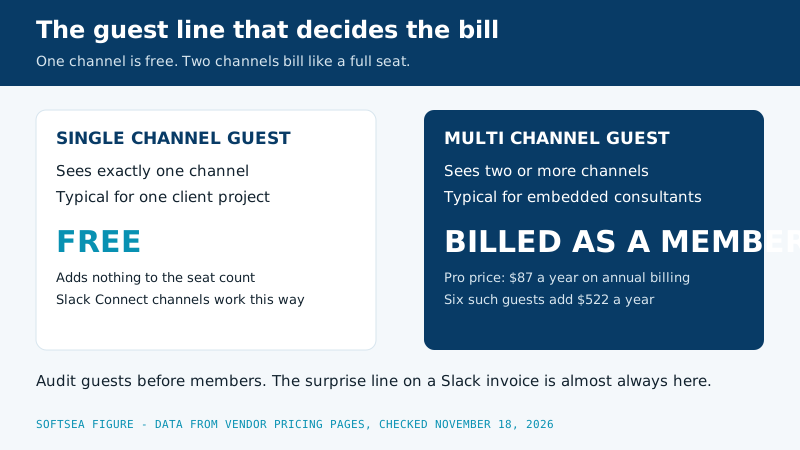
Not every person in your Slack costs the same. Single-channel guests, people invited into exactly one channel, are free. Multi-channel guests, people who can see several channels, are billed like full members. The trap springs in agencies, consultancies, and client work: a client contact added to three project channels is quietly a paid seat, and a handful of outside collaborators can add hundreds of dollars a year that nobody budgeted. Audit your guest list before you audit your member list; it is the line item that surprises finance. The fix is usually free: consolidate a client's channels, or keep outside people in a single Slack Connect channel, which keeps them on the free side of the line.
Diagram contrasting a single channel guest, who is free, with a multi channel guest, who bills as a full member at 87 dollars a year on Pro annual billing
Guest billing, counted properly: a worked agency example
Abstract warnings about guests rarely change behaviour, so here is the arithmetic that changes it. A twelve person agency runs its client work in Slack Pro on annual billing. Staff alone cost $1,044 a year. Over two years of projects, six client contacts have each been added to a kickoff channel, a delivery channel, and a support channel. Three channels each means every one of them is a multi channel guest, billed exactly like a staff member. The real bill is eighteen seats: $1,566 a year. The guests are a third of the spend, and nobody ever approved a purchase called client guests for $522 a year, because it never appeared as a decision. It accumulated one polite channel invitation at a time.
Now run the fix. Each client contact keeps access to a single delivery channel, and kickoff plus support conversations move into that same channel or into a Slack Connect channel shared with the client company. All six guests drop to the free side of the line, the bill returns to $1,044, and the clients notice no difference except a tidier sidebar. The lesson is not that guests are a scam; embedded consultants who genuinely work across many channels are worth a seat. The lesson is that channel count, a setting nobody reviews, is silently acting as a purchasing department inside most workspaces.
Fair billing, worked through three roster changes
The Fair Billing Policy sounds simple and behaves simply, but only if someone on your side works the roster. Consider a 25 person company on Pro with annual billing, a $2,175 year paid up front. In month two, three new hires join. Slack prorates their seats for the remaining ten months, so the true up charge is roughly three seats at $87 a year scaled to ten twelfths of a year, about $217.50, rather than a fresh full year for each person. Nobody is overcharged; the invoice just grows mid year in a way that surprises a finance team expecting a fixed subscription.
In month five, two employees leave and their accounts sit untouched. Once a member has been inactive for 28 days on a plan bought through the website, credits begin to apply against future charges. The catch is procedural: credits reward a workspace whose leaver process actually deactivates accounts, and they arrive quietly, as offsets, rather than as refunds anyone notices. A company that deactivates leavers in their final week keeps its billed roster honest almost automatically. A company that leaves accounts dormant discovers at renewal that it funded a ghost team for months, fair billing or not.
The third change is seasonal. A retailer adds eight temporary staff for a ten week peak, then removes them. On monthly billing, those seats cost eight times $8.75 for each month actually worked, roughly $210 for a three month peak with clean deactivation at the end. On annual billing the same seats invite proration maths and credit chasing that eats the saving. This is the one scenario where monthly billing is not a premium but a tool, and growing firms with spiky rosters should model it before defaulting to the annual discount.
Before you upgrade a tier or renew a year, walk the audit in the tracker below. It takes under an hour in most workspaces and routinely finds more money than any negotiation with a sales rep would.
Interactive tool
Pre-Upgrade Cost Audit Checklist
Check off each step as you finish it. Your progress stays on this page.
0 of 9 complete
0% done
Is the free plan enough?
For a team that treats chat as a hallway, yes, sometimes for years: messages flow, files move, and the 90-day history limit only hurts when someone asks "what did we decide in March." The moment chat becomes the company memory, the free plan's invisibility cloak over old messages turns into re-asking, re-deciding, and re-litigating. That is the real upgrade trigger, and it is about history, not features. Hobby groups, short projects, and tiny teams with a second home for decisions (documents, a wiki, tickets) can stay free indefinitely. Companies whose Slack is the archive should be on Pro and think of the $87 per person per year as rent on the company memory. For now, the honest comparison is Slack against your current chaos, and chaos is also not free.
Who counts as a member, exactly
The per-user price only becomes a bill when you know who counts. Full members count: owners, admins, and regular members with access across the workspace. Multi-channel guests count, as covered above. Single-channel guests do not. Bots and integrations do not; the 10-app limit on the free plan is about how many you can install, not a per-app charge. Deactivated accounts stop counting, which is why the leaver process matters more than any negotiation. One more category catches people out: a person with two workspaces at the same company is two seats, because Slack sells per workspace, not per human. Companies that spin up a separate workspace per department sometimes discover they have been paying twice for the same people, and consolidating workspaces is the single biggest Slack saving available to them. Before your renewal, export the member list, mark every person who appears twice, every guest in more than one channel, and every account untouched since last quarter. That spreadsheet, compared against the invoice, is the difference between Slack costing what the table at the top of this guide says and Slack costing whatever it happens to cost you.
How to keep the bill down
Pay annually once the team is stable; the saving is about 17 percent on Pro.
Deactivate departed employees the week they leave, not at the next audit; fair billing rewards tidiness but does not do it for you.
Keep outside collaborators in one channel each, or in Slack Connect, so guests stay free.
Resist Business+ until a named requirement (SSO, compliance exports, advanced AI) demands it; doubling the bill for headroom is the most common Slack overspend.
Count active members quarterly and reconcile against the invoice; prorations and credits only help if someone checks they happened.
What Slack costs next to the rest of the stack
Slack rarely arrives alone, so it helps to see its price in the company it keeps, at list prices checked the same day. A 10-person team on Slack Pro pays $870 a year. The same team on Zoom Pro for its meetings pays $1,699.20 a year on annual billing ($14.16 per user per month), and on Asana Starter for its projects, $1,318.80. The chat tool is the cheapest of the three core subscriptions, which is worth remembering when a budget meeting goes hunting: the line item that feels like a toy is usually not the line item eating the budget. It is also the subscription with the highest daily usage, which makes its cost per hour of actual use the lowest in the stack by a wide margin. None of this argues for buying all three; it argues for cutting them in the right order. Meeting and project tools with shelfware seats are where stacks leak money, because nobody notices an unused project seat. An unused Slack seat announces itself, because the person simply is not there, in the channel, every day.
Related guides
Readers working through this choice usually weigh the options below next. Each one runs the same vendor checked pricing as this guide.
Pro costs $7.25 per user per month billed annually, or $8.75 billed monthly. Business+ costs $15 billed annually, or $18 monthly. Enterprise+ lists at $45 per user per month on annual billing through sales. The free plan is $0 with a 90-day message history limit. All figures are list prices from slack.com/pricing, checked November 18, 2026.
How much does Slack cost for a small business of 10 people?
On Pro with annual billing, $870 per year. On monthly billing, $1,050 per year. Business+ doubles it to $1,800 per year on annual billing. Add the guest audit: outside collaborators in multiple channels bill as members, so a 10-person company with five multi-channel client guests is really a 15-seat bill.
Is Slack free for small teams?
Yes, and the free plan is genuinely usable: unlimited users can join, channels and direct messages work, and up to 10 apps can be connected. The binding limit is memory: only the last 90 days of messages are visible and searchable. Teams that keep decisions somewhere else can run free for a long time; teams whose chat is the record cannot.
Why did my Slack bill change in the middle of the month?
Because Slack prorates. Adding a member mid-cycle charges for the partial period, and the Fair Billing Policy credits seats that go inactive. The bill is a living number that follows your roster, which is fairer than a fixed contract and more confusing on an invoice. Reconcile it against your member list whenever it moves unexpectedly; the cause is nearly always a joiner, a leaver, or a guest crossing into multi-channel territory.
How are guests shared through Slack Connect billed?
A guest who sits in a single shared channel stays on the free side of Slack's billing line, which is exactly the shape Slack Connect was designed for: your people and the client company's people meet in one channel that belongs to both workspaces. Trouble starts when that same outsider is also pulled into internal channels for convenience, because the second channel is what converts a free guest into a billed member. Keep Connect relationships inside their shared channel and the arrangement costs nothing beyond your own seats.
What happens to the bill when an employee goes on long leave?
The seat keeps billing while the account stays active and used, and the Fair Billing Policy only starts helping after a sustained stretch of inactivity, with credits applied once a member has been inactive for 28 days on website purchased plans. Short absences change nothing. For parental leave or a sabbatical measured in months, deactivating the account in agreement with the employee is the clean route: the seat stops counting, the message history stays in the workspace, and reactivation restores access when they return.
Is Slack Business+ worth it over Pro?
Only for named reasons: SAML SSO and provisioning if IT requires them, compliance exports if legal requires them, the uptime SLA if contracts require it, or the advanced AI features if the team will actually use them weekly. Absent one of those, Business+ is the same chat at twice the price, and Pro at $7.25 per user per month billed annually remains the value point of the whole lineup.